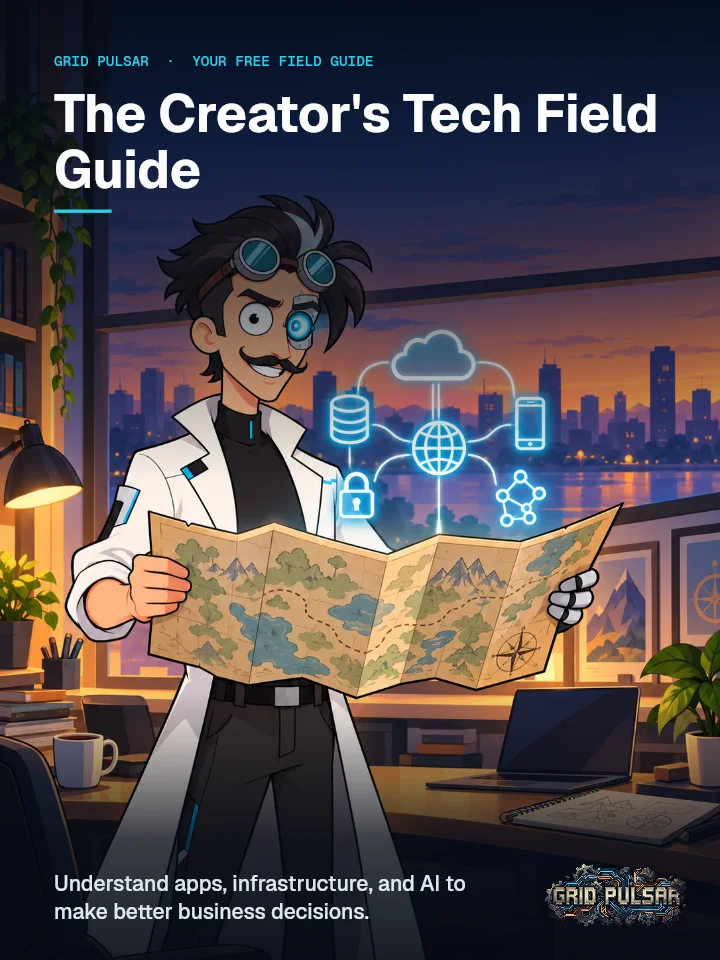
The Creator's Tech Field Guide
Understand apps, infrastructure, and AI to make better business decisions.
Understand the apps, infrastructure and AI your business depends on, without reading code. This free PDF from the Grid Pulsar team helps you weigh costs, judge vendors and ask engineers useful questions.
Every email includes an unsubscribe link, and we do not sell or share your address.
Inside the field guide
- 01
How the Parts of an App Connect
Understand how front ends, back ends and APIs handle a single request, where the product remembers information as state, and which parts make up what you call the app.
- 02
Where Your Software Runs
Compare physical servers, virtual private servers, major clouds, managed platforms, serverless services and containers by the control they offer, the costs they create and the effort they require.
- 03
What Hosting Really Costs
Judge hosting options by what gets billed, introductory and renewal terms, data transfer charges, hidden fees, lock-in and maintenance time, then recognize when moving would justify the disruption.
- 04
From Web Address to Working Product
Trace a typed address through domains, DNS, TLS certificates, CDNs, edge networks and reverse proxies to your product, and understand the basics that help your email reach an inbox.
- 05
Where Your Data Lives
Understand why relational databases are the default, when document or key-value stores fit, how file storage, object storage and caches differ, and why recoverable backups require more than copies, including regular restore drills.
- 06
Protecting Your Product and Its Users
Understand common attacker tactics and ask your team specific questions about accounts, access, passwords, keys, secrets, least privilege, updates, private networks and VPNs.
- 07
Shipping Changes and Keeping Things Running
Understand how version control, releases, deployments and rollbacks move changes to users, and decide what monitoring, alerts, uptime targets and incident responses make your young product reliable enough.
- 08
Choosing AI Models and Understanding Costs
Understand how foundation models generate responses, how tokens, context windows and model tiers affect capability and usage bills, and how to choose a model by balancing quality, latency and cost.
- 09
Building AI Features You Can Trust
Distinguish prompts, embeddings, retrieval, RAG, agents, tool use and fine-tuning, decide when each fits, and ask how an AI feature will be evaluated for quality, controlled for cost and checked for failures and privacy risks.
- 10
Choosing a Stack That Can Grow
Use a decision framework to choose your stack, weigh building against buying, judge vendors and freelancers, ask engineers useful questions and plan for growth without assuming a rewrite.
Who this guide helps
- Creators who depend on software and want to understand what keeps their business running.
- Founders who need to weigh technology costs, compare vendors and decide what to build or buy.
- Entrepreneurs who want to use AI and understand its costs, limits and risks.
- Product architects who plan how a product fits together and need a shared language with engineers.
FAQ
Is the ebook free?
Yes. The ebook is free. Signing up also means agreeing to occasional emails from Grid Pulsar about new guides and reviews.
What format is it?
It is a PDF. After confirming your email address, you can download it straight away. We also email you a download link that works for seven days.
Do I need to know how to code?
No. The guide explains technology in plain English, without code. Each chapter ends with questions to ask and links to deeper guides and reviews.
What emails will I receive?
First, we send a confirmation email. Nothing else is sent until you confirm. After that, we email your download link and send occasional emails about new guides and reviews.
How do I unsubscribe?
Every email includes an unsubscribe link. Follow it and press the unsubscribe button on our site to stop our ebook, guide and review emails.